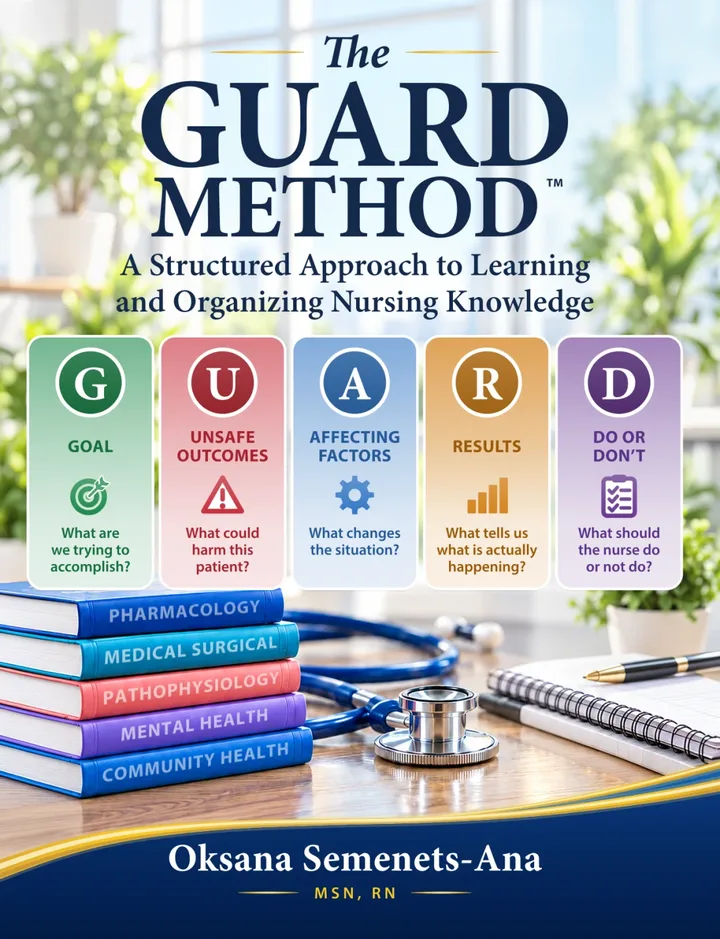
Teach it, share it, credit it
Permissions and sharing
What you can copy, share and adapt from The GUARD Method, and how to ask for anything else.
The short version
You never need copyright permission to teach or apply the GUARD Method itself, including in paid courses, using material you wrote yourself. Please follow the trademark notes below when you name it.
What this page covers
This page explains the permissions printed on page ii of The GUARD Method (first edition, 2026, paperback, ISBN 979-8-9823847-0-6). The licensed part is pages 56–92. The rest of the book follows its copyright page: all rights reserved, with fair use and other legal exceptions still applying. This page explains page ii; nothing on it narrows the permissions printed there.
Who grants these permissions
The copyright permissions on this page, including the additional course permission, are granted by the author and copyright owner, Oksana Semenets-Ana. The book is published by NurseHQ, an imprint of Scrub Campus, LLC. Scrub Campus, LLC, operates this website and gives the trademark notes below.
The licence: CC BY-NC 4.0
Pages 56–92, including the FACULTY pages, are licensed under the Creative Commons Attribution-NonCommercial 4.0 International licence (read the licence). They contain the book’s two cases (Linda Carter and Angela Brooks), the faculty worked examples and the faculty toolkit, and each of those pages carries the licence in its footer.
Nothing on this page narrows the rights that licence gives you.
Additional permission for for-credit courses
Page ii grants it in these words:
As an additional permission, you may also use them [pages 56–92] with students in for-credit courses at any institution, including tuition-charging and for-profit ones. Other commercial uses need permission.
The permission is given by Oksana Semenets-Ana. It means the licence’s NonCommercial limit does not stop that use, for example copying, sharing or adapting the pages for your class, or posting them in your course site or learning management system. The licence’s other terms still apply, including credit, noting changes and its disclaimer of warranties.
How to give credit
Use this credit, or something equivalent, with a link to the licence:
The GUARD Method, guardmethod.com, CC BY-NC 4.0 (creativecommons.org/licenses/by-nc/4.0)
Online, you can link “CC BY-NC 4.0” to the licence instead. If you share the pages as laid out in the book, keeping their credit footers does this; in slides, a course page or other formats, give the credit in any reasonable way. If you changed the material, say so, for example: “Adapted from The GUARD Method, guardmethod.com, CC BY-NC 4.0 (creativecommons.org/licenses/by-nc/4.0); questions changed.”
Faculty worked examples
The faculty worked examples and answer guides on pages 56–92 are under the same licence and course permission. They demonstrate reasoning; they are not secure exam keys. If you use a case for assessment, the author suggests sharing the faculty example after students have answered.
Trademarks
GUARD Method™ and NurseHQ™ are trademarks of Scrub Campus, LLC. Neither the CC licence nor the course permission grants trademark rights.
- Welcome: referring accurately to the GUARD Method when you teach, write, research or describe your course (“a course using the GUARD Method”). No permission is needed.
- Please credit: on first mention, “GUARD Method™ created by Oksana Semenets-Ana” is appreciated.
- Copies and adaptations: copies of pages 56–92 may keep the GUARD Method™ name as printed. If you adapt them, make clear the version is yours (for example “Adapted from The GUARD Method”), not an official GUARD Method publication. Neither implies endorsement.
- Please don’t: use GUARD Method or NurseHQ as the name of your own course, product, service, website or organisation, or suggest that it is official, certified, sponsored or endorsed by Oksana Semenets-Ana, NurseHQ or Scrub Campus, LLC.
Nothing here limits fair use or other uses the law allows.
Educational use
The cases are fictional and for teaching. They are not clinical guidance and do not replace clinical judgment, current standards or institutional policy. Do not enter real patient information into the materials.
Asking for permission
For anything not covered above, copyright or trademark, write through Oksana’s contact page. Please say who you are, what you want to use, how and with whom, how many learners, and whether the use is commercial.
Changes
This page is dated 25 October 2026. Its explanations may be updated. Updates never withdraw or narrow the CC licence or the course permission printed on page ii of the first edition.